The 2022 Mount Desert Island Marathon: Secrets of the Dawn Land
Start Location: Bar Harbor, ME
Mount Desert Island is a rugged mass of land off Maine’s southern shore, separated from the mainland by a salty strait known as the Mount Desert Narrows. Looking at the map, its island nature is easy to overlook. The stretch of water that divides it from the mainland—called the narrows—is a mere 1500 feet across at its slimmest point.
The island is defined by a chain of granite mountains—rounded domes and exposed ridge lines sculpted from immense sheets of rock. When Samuel de Champlain first sighted these stark peaks in 1604, their bare, windswept summits inspired him to name the place Isle de Monts Deserts— Isle of the desolate mountain.
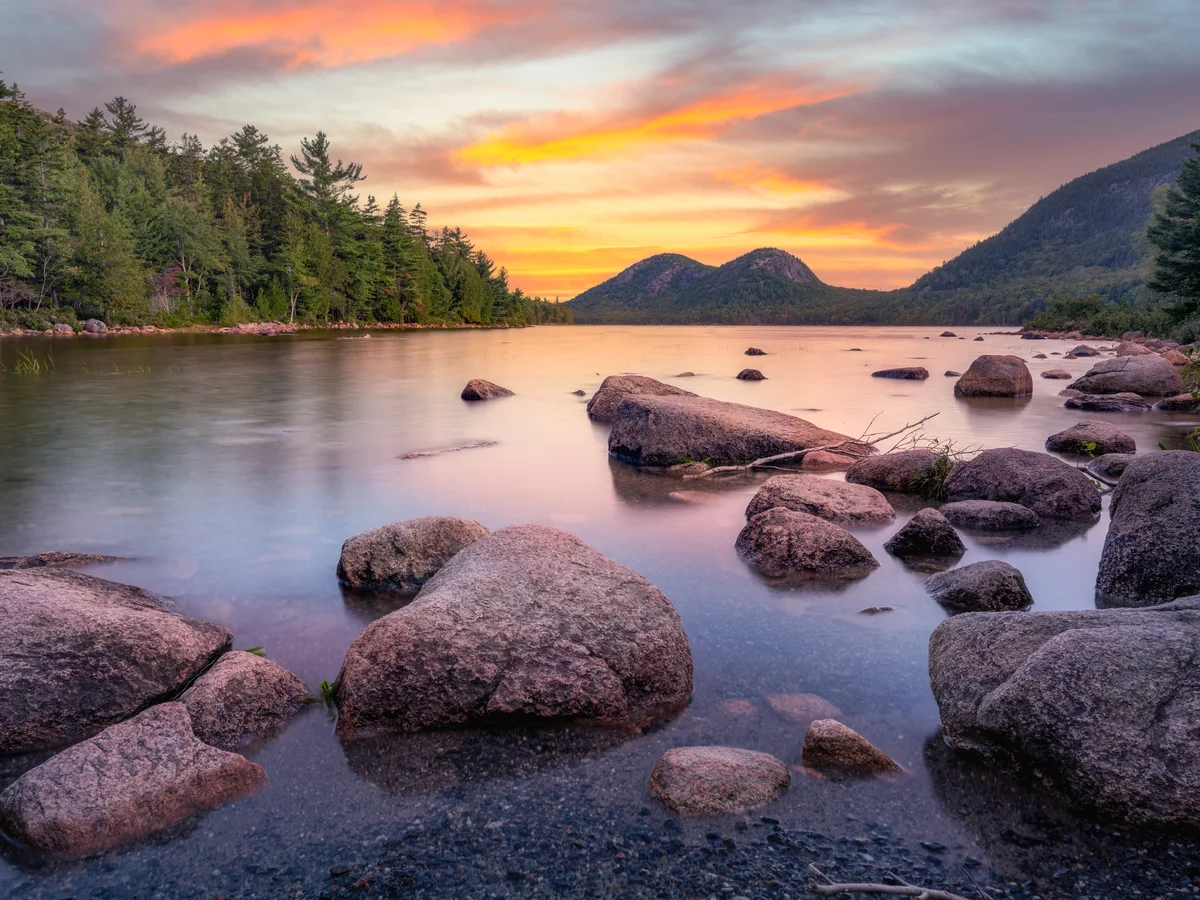
These mountains plunge into a dramatic landscape of steep cliffs, rocky points, and reflective tide pools. A lattice of lakes and streams cut through the island's forests and meadows. And carved deep within the highlands lies a circuit of U-shaped valleys— the lasting signature of eons of glacial erosion.
Glacial lakes and ponds dot the landscape, and dense spruce–fir and hardwood forests rise nearly everywhere one turns. Along the coastline, the land frays into a series of tidal inlets and rocky intertidal zones where crabs, periwinkles, and other marine creatures thrive in the churning surf. Lobster boats bob against the docks in small fishing villages tucked amid the island's harbors.
At the island's heart stands Cadillac Mountain, which rises 1,530 feet above the sea like a fabled sentinel peering out at the Atlantic amid the fog and behind the conifer— a protector to the mysterious interior of North America’s shore.
But the island still holds the spirit of its original inhabitants. The Wabanaki came and went from the island in birch bark canoes. They’d hunt, fish, gather berries, and harvest clams. They made baskets and erected wigwams— small huts made of birch bark— and though our modern world has become a busy place, here on this island—in the fog and at the headland—the forest still whispers in the breeze and sings songs to all who wander there. The echoes of a simpler time. Of quiet serenity on an island where the sea meets the land.
MDI
A year had passed since I'd run my first marathon. The experience had left me wanting more, and now the time had come to continue on my journey. The Mount Desert Island (MDI) race would serve as a proper challenge with which to complete my second attempt at 26-mile glory. The coastal racecourse was notorious for its beauty but also for its hills, and I expected it to be starkly more difficult than my first experience. That course had been in the forests north of Keene, New Hampshire— an event that enjoyed a small net elevation loss.
I had learned much in that first race. Indeed, my training cycle had more bumps in the road than any of New Hampshire's most neglected sidestreets— lessons that were earned the hard way. First among them, the importance of listening to the body's subtle pleas. Pushing too hard during training for the sake of reaching weekly milestones isn’t worth it, I would find. It’s a surefire way to get injured, and those injuries can shut down training for weeks on end.
Lost miles are lost performance when the big event finally comes, or worse, you might not race at all. To that end, I shifted my priorities this second time around. The focus needed to be on long-term achievement, not short-term benchmarks. A runner must know when to tactfully retreat. Heal up fast and live to fight another day.
To that end, I went into this training season with one clearly defined goal. Don’t get hurt. But it wouldn’t be easy. After all, I would still be up against many of the same challenges that plagued me the previous year. Namely, the heat. Most of my 18-week training fell in summer once again.
The problem that summer poses is that my body is prone to excessive sweating and dehydration. It doesn’t help that I mostly do my running in the afternoon when the day’s temp is at its hottest. The timing, while not ideal, is crucial for fitting running into my schedule, so there was no way around it.
Reflecting on the previous year, I came away realizing that I needed to take hydration more seriously. I did much better this time around, and it did well to alleviate many of my issues. When running far from home, I started carrying water with me using a hydration backpack. But mostly I opted for loops around the neighborhood. Leaving a jug of water in my driveway, I was never far away from my next drink. As a bonus, it also made it easier to call off a run if things went south.
But as it turns out, over the course of my 18-week training regimen, I only had to call off a run once. That was in upstate New York, visiting with family in the humid, verdant farmland of Wayne County. I was doing 4-mile loops and sweating like there was no tomorrow. It was to be a 20-mile run on an especially hot and humid day. In fact, that day would clock in as the hottest day on record in 2022. It was at mile 16 when I finally made the call. I was losing water way too fast, and I knew I had to end it.
Despite my efforts to play it safe, I still sustained a mild tendon injury that would impair my running for a few weeks afterward. When the body gets dehydrated, not only does it affect the runner’s form, but it can also lead to inflammation of the tendons. The damage that’s done often doesn’t present itself right away, and so it can be hard to realize when the body’s in trouble. That’s what happened on this day. I stopped at mile 16, but upon later reflection, I concluded that mile 12 would have been the proper time to tap out. I was just losing so much water.
Despite this single incident, the overall training season was a smashing success compared to my first time around. I was training smarter and getting injured less. My willingness to call off my run that day showed that I was becoming a savvier athlete. But it was important never to let this come at the cost of my drive to push forward. It would be very easy for excuses to stop running to sneak their way into my psyche. These sly little calls to stop running—my subconscious mind’s attempts to justify them—are the bane of any runner. Marathoners learn to push this thinking aside. The danger, then, is allowing it to return.
In this case, I experienced significant disappointment that I would not meet my weekly mileage. I decided this would be a useful gauge to assess whether such dangers were sufficiently quelled. As long as there is disappointment, it shows that the desire to press on has not been compromised. These are crucial skills for anyone who aspires to run multiple marathons—finding a balance between dogged determination and forward-looking patience—and I was pleased with how far I’d come.
Now, as I made my way north toward the rocky northern shores of Maine, I felt like I was good to go. The only grumbling I had about my current plans was the 5 hours of driving that it would take to get there. My first marathon had been only 90 minutes from home. This race, however, was so far up in Maine, I might as well have been driving to Canada.
Of course, I could have just done the same marathon as last year—the Clarence DeMar Marathon in Keene, NH. But I’d decided I'd rather move on to something new. And to be honest, I had been playing around with the idea of running a marathon in all 50 states. Of course, it seemed like a pretty lofty goal for someone who’s so new to marathoning. But I had effectively caught the bug, and my last marathon had left me thirsty for more.
Plus, I needed to bring some joy back into my life. Running had for the past several years been becoming my predominant pastime, as I’ve sought to weed out more expensive sports and hobbies that I no longer have time for. And I liked that the 50-state goal would provide a great opportunity to travel a bit.
Still, I wasn’t getting too ahead of myself. 50 states would make for a lot of marathons. I wasn't sure if it would ever work out, but I decided I would align myself with this goal from the beginning. That way, if I did end up getting serious, then all my races will have counted toward such an end.
I chose MDI based on the beautiful location and the abundance of praise from online reviews. My other option was to do a marathon in Portland ME, which would have been much closer to home and was happening around the same time. However, in reading about the Portland race, I didn't jibe with vibes. My first race a year earlier had spoiled me. The Clarence DeMar Marathon in Keene, NH, had been a top-of-the-line production, and now I wanted to do another race that was equally lauded. After all, it isn’t just about the run; it’s about the whole experience, and from what I’d read, the Mount Desert Island Marathon in Bar Harbor was the race I was looking for.
The Pine Tree State
Time passed slowly as I made my way north. The mile markers were a blur amid the asphalt backdropped by green thatchy pines. Having to make multiple turns in the first sixty miles, the first hour passed slowly. Finally I made it to the border of New Hampshire and Maine. My mood was apprehensive, to put it lightly. The expense of the trip was weighing on me. As an adult college student with two children at home, I had grown accustomed to doing everything on a budget these past few years, and I decided going into this trip that I would have to keep costs down any way I could.
Running is typically a pretty cheap pastime. It doesn’t cost much more than a new pair of shoes here and there. Marathons, on the other hand, are a different story. There is the registration fee--usually about 120 dollars-- and then there are the travel expenses-- gas and lodging. When you factor all of these together, running becomes as expensive as golf.
Most marathoners treat these trips like mini vacations. Their weekends are filled with fine dining and sightseeing. But for me, at this stage in my life, I can't justify such expenses. I would have to minimize expenses wherever I could. The registration fee might be unavoidable as was the cost of gas, but at least I could steer clear of pricey hotels. But in New England, even a swanky room in a Motel 6 can go for up to $400 a night in a sought-after tourist destination on the coast.
My plan, then, was to eliminate lodging expenses altogether by camping out in the back of my truck. Conveniently, my trusty Silverado is equipped with a hard-cover cap, under which there would be plenty of space to lay out a futon. The windows on the cap could be slid open for fresh air, and are also tinted, providing privacy. Comfort wasn’t my primary concern, however. Rather, I was more worried about finding secure parking. It would be important to eliminate the risk of having my sleep interrupted in the middle of the night.
In checking the race information page, I learned that participants are recommended to utilize street parking, which is abundant and free to use on the day of the race. But what I really needed was a safe and quiet parking area, away from the busy streets. Fortunately, the MDI race website mentioned such an option—a middle school parking lot about a mile from the starting line. With any luck, it would be a proper place to spend the night. Fingers crossed.
Bar Harbor:
Perched on the craggy edge of Mount Desert Island—where granite cliffs plunge into the cold, blue sweep of Frenchman Bay—Bar Harbor is the quintessential Maine town. with restaurants adorned by colorfully painted lobster buoys, and quiet streets lined with historic shingled cottages, 19th-century grand mansions, and coastal Victorian architecture. Here the spirit of Maine's fishing community endows at every corner, and everywhere amid sun, and in the fog, there is the crisp and molted scent of salt and sea.
As I drove into town, I made my over to the local YMCA to pickup my race packet and check out the expo. Parking was a bit of a challenge since the building was designed for locals, but before long, I found myself a space across the road, in the grass near an adjacent baseball field. Soon I was inside and walking around the expo. A feeling of excitement came over me, as I began to feel swept up by the energy of my fellow runners coming and going from the building.
Things moved swiftly from there. The volunteers very friendly and seemed well-organized. The crowd inside was light, which made for a low-stress atmosphere. I received a pink MDI bag with the race’s signature Joshua tree logo printed in white. The bag had two straps on it, which allowed it to be worn like a backpack. Inside, I found my race bib, an MDI course map, and a long-sleeve shirt. The shirt was light blue, and made of a thin synthetic silky material.
After leaving the Y, I headed across town to check out the middle school, where I hoped to secure parking. I was relieved when I pulled into a quiet, empty parking lot, hidden from the town’s streets by trees and shrubbery. The atmosphere seemed pretty laid back. This would be a fine place to sleep for the night. I just hoped that my truck wouldn’t attract unwanted attention. To alleviate this, I decided to place my racer’s bib on the vehicle's dashboard. This would make clear to any security or police who happened by that I was there with the marathon.
Leaving my truck, I proceeded on foot, turning left out of the parking lot and following Mt Desert Street east toward the center of town.
I had never been to Bar Harbor before, but I had been to other coastal areas of Maine in my youth and had fond memories of this far northern state, with its dark rocky shores, expansive waterways, and tucked-away coves.
My greatest regret for this trip was not being able to bring my family along. Acadia National Park, which spans the vast interior of the island, would have been a fine place to take them. But sadly, there was little time for pleasure this weekend.
Since I was buried in schoolwork, there simply wouldn’t be enough time to make a meaningful vacation out of it. In fact, there wasn’t even enough time to take a quick look at the park myself. My Saturday so far had been taken up by first packing, then driving, and now I had race logistics to figure out.
For that reason, I had begrudgingly let the opportunity pass, vowing to myself that once I was finished with college, I would make better use of these races as opportunities to travel with family.
I arrived at the center of Bar Harbor in the area known as Village Green, a grassy park area that would serve as the staging area for tomorrow’s starting line. There were many tourists and runners strolling leisurely around. Music was playing nearby, and this center of town had a festive and jovial atmosphere. I nodded approvingly, then proceeded to walk south down the main street where tomorrow’s starting line would be found.
Along the main street, there were many small cafes, restaurants, and bars. The Choco-Latte Café, the Blaze Grill, and Leary’s Landing Irish Pub. The main street quickly petered off, and I found myself back in the area of the YMCA. A quick backtrack to Wayman Lane had me turning east toward the ocean. When I found the water I turned north onto The Shore Path, which follows the coastline. From here, I was afforded my first glimpse of the immense size of the greater Bar Harbor Bay, with its scattered islands and distant shores.
The town of Bar Harbor exists on a little node-like bulb of land that bulges out of Mount Desert Island like a barnacle on a rock. The result is that it increases the amount of coastal frontage surrounding the town.
Certainly, one of the greatest appeals to visiting Bar Harbor is the harbor itself. With its deep green-blue waters and sprawling islands from Mt. Desert Narrows to Frenchman Bay. The life of a Bar Harbor resident is a life that is one with the sea.
I wouldn’t have time to do much sightseeing. But at the very least, I wanted to get to the water and let the spray of Bar Harbor flow through my hair. I followed the path north, past the backyards of many large residences overlooking the sea. Eventually, the path took me back into a commercial zone, and I ended up down at John D. Ellis Pier. Home to the Harbormaster, the Bike Rack Fish House Grill, and the Bar Harbor Whale Watch tours.
I was at the northern end of town now, and I made my way along West Street past Agamont Park, Paddy’s Irish Pub, the Eagles Nest, and the infamous West Street Hotel. I had a moment of envy. The hotel was only a block away from the starting line. I knew there would be many racers staying there, and I envied the convenience with which they could walk out of their hotels and begin their race tomorrow. But at five hundred dollars a night and sold out anyway, I was inclined to pass.
I had another idea, though. I decided to check out the finish line down in Southwest Harbor, so I started walking back toward the middle school to get my truck.
Southwest Harbor:
Normally, I don’t do much to check out a race’s course beforehand. At most, I just look at the map. But as I drove along the coast in the afternoon sun, following my phone’s navigation to Southwest Harbor, I found that my directions almost perfectly overlapped with the route I’d be following the next day.
The MDI Marathon follows a one-way course that begins in Bar Harbor on the east side of the island and ends in the small fishing village of Southwest Harbor. This course follows the coast of the island pretty much the whole way, making it one of the most scenic marathons in North America. For 26 wonderful miles, racers are flanked by the Atlantic Ocean to the left and the towering mountains of Acadia National Park to the right. All as the fall foliage of the island’s interior sheds its summer coat lightly into the ocean breeze.
However, the route, though rounding the coast, does not follow a strictly circular pattern. This is because Mount Desert Island is split in the middle by Somes Sound, a Fjard characterized by a shallow center and formed by glaciers. This narrow waterway is gouged across the landscape from north to south and serves to split the island nearly in 2. Though shallow, it is a vast waterway over which no bridges have been built.
When racers reach the southernmost point of Somes Sound in the village of Northeast Harbor, the course will turn north and head along the edge of the sound. Then, when the waterway comes to an end at the village of Somesville, the route returns south toward Southwest Harbor on the other side of the split.
As I drove along, I couldn’t help but marvel at the scenery. My excitement was growing in leaps and bounds, but still, I was distracted. I had a final decision to make.
When I arrived in town, what I found was a sleepy little fishing village that was even smaller than it appeared on the map. There were a couple of restaurants and shops here and there: an ice cream shop, an inn, and a local bank.
Turning off the village’s main street, I found myself pulling into a small parking lot outside the local post office. I put the truck in park and decided to get out and walk around.
Pursuing the town, I got a glimpse of the harbor. It was small. In the distance, I could see sailboats moored, and along the coast, there was an assortment of marinas.
Walking along the main street, there didn’t appear to be many people around. I was expecting more tourism. I had pictured this town being like a miniature version of Bar Harbor, and though there was a small line outside the ice cream shop, overall, this town didn’t seem to have much going on. The main street was so small that it was the kind of town you could drive right through without seeing it.
But my reason for coming down here wasn’t to do the tourism thing. I was looking to inspect the layout. The reality is that I had been wrestling with a key decision about whether or not I wanted to rely on bus transportation back to my vehicle on race day, and I was thinking about parking my truck down here instead.
Since the marathon is a one-way, there would be buses to return racers to their vehicles left behind in Bar Harbor. The problem for me, as I saw it, was that I had a 5-hour drive home after the race. I knew I would be extremely tired and that my exhaustion would only grow as the day went on. I thought I would benefit from being able to get that drive done as soon as possible. That would mean parking and sleeping at the finish line and getting up to Bar Harbor in the morning somehow.
I figured if I could take a taxi up to Bar Harbor in the morning, then my truck would be at the finish line, and I could leave immediately after the race. But there was only one taxi service on the island that claimed to be available in the morning, and there were risks to this, of course. In speaking with them, they assured me they would be able to pick me up at the requested time. Still, I would be relying on a single driver. If they didn’t show, then I would have to spend my morning driving back up there and scrambling to find parking, all while still having to rely on the buses.
Now, as I walked around this sleepy little town and evaluated the parking situation here, I was unsure that I could make it work. The parking lot at the post office appeared to be my only good option. But it felt a bit exposed. More problematic still, just based on the way the town was laid out, it appeared that I could have difficulties exiting that parking lot on race day. I wasn’t sure exactly where the finish line would be. I knew it would be on Main Street, but if it was any further south than the parking lot at the post office, then it looked like I might be boxed in completely. With no way out whatsoever.
So, with that idea dead in the water, I climbed into my truck and began my drive back to Bar Harbor. It was a decision that would come into question the following day.
The Night Before:
There is something mystical about Mount Desert Island. The land that towers over the ocean is hidden in fog and shrouded in the ocean spray from easterly winds. It stands in perfect stillness, and though it is quiet in its embrace, one cannot ignore the sense that this island has a thousand secrets to tell, and in every corner of the island, one can feel the soul of this place quietly whispering into the wind.
An old Abenaki creation story tells a tale of the very beginning. The tale of Gici Niwasw, the great spirit, who lived in a primordial ocean wholly devoid of life and light. Back before, there were colors or even sounds. Back when the soup of creation was formless and empty.
But it would not be right to let such primordial potential go wasted for all eternity. And so, one day, Gici Niwaskw called upon the Great Turtle, Tolba, to emerge and form the land. And on the back of this turtle, the great spirit set about creating the world we know. And when the great spirit was finished and drifted off to sleep, she dreamed of all the plants and people that ever were and ever would be. And in a twist of fate that took even Gici Niwaskw by surprise, she awoke the next morning to find that her dreams had become manifest. That all the plants and creatures of her dreams had become her reality and that the world was teaming with life.
That’s the story, anyway. Of the Abenaki people. Part of the Wabenaki Confederation native to these lands.
Such a history seemed a world away when I found my way back to the parking lot of the middle school in Bar Harbor. The sun had set, and dusk was upon me as I backed up my truck into a nice parking space beneath the trees. Climbing into the back, I rolled out my futon mattress and sleeping bag. I fluffed up my pillow, drank some water, and changed into my race clothes. I felt excited but also a little nervous.
Still, I wasn’t half as apprehensive as I was for my first marathon. That’s just a different animal. The threat of the unknown. The reality is that once you’ve completed at least one marathon, the pre-race jitters lose their edge. The fear of failure is effectively removed because you know you can do it. And even if you don’t complete the upcoming race, you still have the first success to stand on.
But I had no fears that I would not succeed. I was feeling good. My training had improved by leaps and bounds compared to my first go-around.
Or maybe it was just the calming tonic of this magical place that soothed my nerves and coddled my dreams. The air felt warm for October as I lay on my back, listening to the soft blowing wind. This was Summer’s last dance, so it seemed; its last wave before saying goodbye, retreating into darkness, and leaving only the cold, harsh chill of winter.
I could hear small animals in the patch of trees and further in within the thickets. There was Music playing in the far-off distance of Bar Harbor’s main street. Every once in a while, a car or two would pull into the parking lot and then exit soon after.
With nothing left to do, my thoughts became slow. I thought about school— my decision to go to college at the ripe old age of 39. I thought about my growing family— my two daughters. The youngest was born earlier this year. I thought about all the many things my family needs. I thought about how I wanted to give them the world. That I had a vision. A plan for our future. But that it would take time. But how much, I could not say.
My body was still. The warmth of the night enveloped me. I felt perfectly at ease in that moment. A rare thing. There hadn’t been much time for contentment these past few years. But now, as my thoughts faded away. I felt a small spark of peace. That thing I once had. The thing I was desperately trying to get back to. I had glimpsed once upon a time. The kind of peace that one is afforded when everything is going well. When there is space to stop, pause, and soak it all in. Without worry about your boss, or the bills, or all the threats out there.
The charm of Bar Harbor is in its coastal timelessness. Its coexistence with land and sea. Here the mountains of the northernmost reaches of the eastern United States hover over the harbor like giants guarding the land within. The people here live their lives irrevocably tied to the sea. With Maine’s black and rocky shores.
That I would find myself this far north, on this night in October with the warm holding out at its peak and nearly giving way to retreat, I could nearly hear the ocean not far off in the distance, As its waves crashed over rocky shores. I heard it as rhythmically as the incoming surge and retreating tides. And with that, I was fast asleep.
Race Day:
I awoke in the early morning darkness to the sound of waking streets. Cars were beginning to pull into the parking lot— other racers, utilizing the free parking offered at the school. I checked the time. It was 6 a.m. Throwing on my shoes, I climbed out of the back of my truck. The air felt thick. The taste of the ocean. A cool morning fog.
I hopped into the cab and turned the keys in the ignition. As the engine warmed, I took a moment to assess my condition. I felt strong. Rested. This was good.
I wanted coffee. But I had decided the day before that I was going to try abstaining from coffee for this race. One of my greatest challenges in my first marathon was constantly feeling like I needed to use the restroom and only having a few sparse opportunities to do so. It definitely affected my ability to enjoy my run. I hoped to avoid such an outcome for this race. They say caffeine can help enhance performance because it has pain-relieving effects. This I true as far as I can tell, but it also is a diuretic, and if it’s causing you to have to stop repeatedly throughout the race, then that can cause huge problems of its own. It just doesn’t feel like a neutral trade-off. In my experience so far, caffeine has held me back.
It wasn’t going to be easy, however. I love my morning coffee. But I was all business this morning. My training these past 18 weeks had been nearly flawless, and I wasn’t going to throw all that away for a moment of weakness on race day.
My plan at this point was to drive into town and utilize the street parking a little closer to the starting line. Though it wasn’t as secure as this parking lot, it would give me more time to prepare this morning while also minimizing my return time after the race. So, I put the truck in gear and started driving toward the Village Green. Down the road a ways, I found a I nice little parking area across from a Hannaford grocery store just a couple of blocks from the starting line.
After figuring out how to use the parking meter. I found my toothbrush and toothpaste and was preparing to head for the bathroom at Hannaford. I looked at the time. Everything was going along smoothly. I aimed to be at the starting line by 7:30. The race would start at 8. This would provide plenty of time to stretch and get warmed up.
As I finished straightening up my things, another racer pulled in next to me. I watched as he struggled to figure out the parking meter. He asked how it took the money, and I told him there was an app he had to download. We began chatting further. The gentleman was in his 50s, a doctor from Connecticut, who related a story to me about being registered for this race the year before when it was canceled due to an uptick in covid-19 cases. He related the frustration he felt over that. While it was nice talking to him, as he continued on and on, I was becoming increasingly aware of how he was messing up my timetable. I wanted to be at the starting line with a half hour to spare, and I had appropriated myself just enough time to run over to Hannaford, use the bathroom, brush my teeth, and walk over to the Village Green.
I smiled politely as I fumbled with the toothbrush in my pocket. At this point, I wasn’t even listening. It occurred to me that I had better keep my mind on my to-do list, lest I risk making an error, like forgetting a crucial item in my truck. What did I still need to do? Grab my running belt. Drink water. Eat breakfast.
Finally, he released me from his elaborate back story, and we said our goodbyes. I made a mental note that for the next race I would have to apportion additional time for chatting. I rushed off in the direction of the grocery store and checked the clock. Only five minutes behind schedule.
After, brushing my teeth and shaving, I ran back across the street to my truck and scarfed down a quick meal. A salad with lots of beats. Oatmeal, with raisins and chopped apples. I drank some water, then went to work pinning my race bib to my shirt. Then, with that all out of the way, I grabbed my running belt, and I was off.
I arrived at the Village Green to a quiet scene as hundreds of racers went about their morning routines, using the grass, and the pavement to stretch and warm up.
The air was warm for an October morning, and I felt only the slightest chill as I strolled about in my shorts and t-shirt. The sky way a gray white and a light fog hung over the town of Bar Habor, like a thin morning soup. I had a last-minute thought that I wish I could have some coffee. But it was too late now. The opportunity to buy coffee had already passed. But really this was for the best. For the first time, I found myself not needing to make a frantic last-minute bathroom trip before the start of the race.
As we approached the top of the hour, I began seeing people moving in the direction of Main Street. It was five minutes before the start of the race. The time had come. I walked across the grass and turned onto Main Street. The road here went slightly downhill, providing the feeling of us all being positioned at the top of a ski hill, posed to lunge downward. The starting line quickly came into sight. I found my place among my fellow racers and packed myself into the crowd.
Standing near me were two young gentlemen dressed in flagrant American flag-themed attire. They were already shirtless and lean. One had blond hair and was clean-shaven, while the other had long brown hair and a bravado mustache. The one with the mustache smiled often, while the blond-haired one seemed serious and reserved. In their matching attire and simple, contrasted features, they reminded me of Lewis Carol’s Tweedledee and Tweedledum.
I stood tall, eyeing the road ahead. Eager to get started. Somewhere in the pack of the pack, a middle-aged male runner began to holler, “Get ready! Make a hole! Make a hole!” Apparently, he was planning on a fast start. The crowd chuckled. Then came the national anthem. Afterward, the race director initiated the race by blaring music. The race start was signaled by the blast of a cannon. And with that, we were off.
As I ran along the quiet streets of Bar Harbor, I was surprised at how relaxed I was. There really is no marathon like the first, when the fear of failure hangs over you like a nagging ghoul. But with these first-timer jitters out of the way, there is nothing to do other than enjoy the run while simultaneously bracing for the inevitable struggle that lay ahead.
It wasn’t long before the streets of Bar Harbor faded into the horizon. The simple Main Street slowly morphed into Highway 3, the same road I had navigated the day before, but this time, it was closed down to accommodate the droves of runners. The smell of the ocean came from nearby shores, and the towering cliffs of Acadia National Park were to our right.
The first five miles went by without much of a thought. I simply took in the scenery. Surrounded by forest. It had been a warm autumn. The fall foliage though bright, was still just getting started. And hills of dark green still stood as a backdrop to the lightly fluttering colors of red, yellow, and orange. The trees were mostly masked by the fog, and looking out across the long stretch of highway, saw the multicolored assortment of runners brightly dressed in race-day gear.
Around mile 7, we left Highway 3 and the course made it to the coast along the rocky cliffs of the island’s south shore. These were residential areas. Cooksey Drive at East Point, Peabody Dr, near Crowninshield. I marveled at the majesty of these homes, and their connection with the ocean. They stood on high rocky cliffs, looking south of the Atlantic Ocean. On this morning, they were mired in fog, and I found myself wondering what it was like to watch the weather from such a lofty view. To wake up every morning, being able to look out for hundreds of miles.
I myself was a forest dweller. Living in the hemmed-in tumultuous hills of New Hampshire.
But with the increase in value of these homes came a certain expectation of privacy and apparently It would seem not everyone from these neighborhoods welcomed this annual marathon. It was somewhere on Boat Wharf Rd that I began to sense that a vehicle had crept up behind me. When it didn’t pass right away, I glanced back and saw that the driver appeared frustrated. She was urgently looking to find a hole in the mass of runners.
A moment later, she seemed to find one and I felt her SUV speed by me with the engine whining. Then she screamed, perceivably directed at me, “Get out of my fucking neighborhood!”
There were a couple of volunteers at the corner ahead. Their wide smiles faded to horror as the enraged driver sped by. For them, it was a dark stain on an otherwise bright day. Fortunately, the course soon turned back onto Highway 3, and I was out of this neighborhood, swiftly leaving behind any baggage that might have been attached to it. Such is the way with running.
The course continued to follow the coast from here, and as the day became warm, and the sun rose up over the ocean, I was treated to sweeping views of beautiful rocky shores to my left. The fog had now cleared, and it was shaping up to be a beautiful day.
There were a couple of runners ahead of me who I had fallen in pace with. They were young, in their early twenties. A male and a female. They chatted with one another as they ran, and though I hadn’t spoken to them, they were beginning to feel like old friends.
The course then came to a small harbor where various sailboats could be seen moored out amid the dark blue inlet. At the northernmost point of the harbor was a quaint little beach, somewhat covered in strings of black sun-dried seaweed. There were various folks out on the beach enjoying the sun. The course then looped around the harbor, leaving behind Highway 3 and heading south onto Harborside Road. At that point, we began to climb what I considered to be the first formidable hill of the day, as the road climbed up the rocky shores toward the village of Northeast Harbor.
We were approaching mile 12 now, and I heard the young couple speaking ahead of me. The girl’s tone was beginning to change. There was a desperation in her voice as she seemed to be out of breath for the first time. The high was wearing off. We had been running those early miles on fairly mild terrain, dazzled by the fall colors and full of the love of the run. Now as we approached the halfway mark everyone was reaching the point where it wasn’t all fun and games. The girl related this to her friend to some effect, then a moment later added, “I’m still having a good time though.”
At the top of the hill, into the streets of Northeast Harbor, we were met by a surge of onlookers, who cheered and screamed and offered words of encouragement.
The young man ahead of me was spotted by his father, who rushed to his side to cheer him on. The pride, the energy, and sheer show of positivity that his father exuded warmed my heart, and yet I couldn’t help but feel a sense of remorse and loneliness that I did not have that type of support of my own. But I let the feeling pass, choosing instead to enjoy vicariously their father-son bond.
A mile later, we were leaving the streets of North East Harbor behind and once again heading north along what would be a six-mile stretch up the coast of Somes Sound. Much of which I had missed the previous day because my route had kept me on Highway 3.
I didn’t realize it at the time. But here in North East Harbor, despite having 16 miles left to run, the finish line at South West Harbor was only a mile away, on the other side of Some Sound. Not more than a quick boat ride. But, of course, this pack of runners would be going t


Comments